

We often receive questions about short and long-term recreational vehicle use on private land. Many people simply want to camp in their RVs for a few days at different intervals throughout the year on their own land. Others want to permanently live in their RV. Both options require particular considerations.
Short-Term Camping
Most states allow for a version of short-term camping, though a permit may be required. However, in most cases, local zoning requirements will be the code to research and follow. Often a code will restrict the number of days permitted for camping, as is the case in Costilla County, Colorado (see Section 5), where more than 14 days within 3 consecutive months on the same parcel is not allowed. In Putnam County, Florida in areas zoned Residential, camping in an RV cannot exceed 14 consecutive days or 120 non-consecutive days in a given calendar year without a permit. The number of days may even vary within a county based on the zoning designation. Longer periods still considered temporary usually require a permit. These cases may include land clearing, during home construction, and extreme hardship, as is the case in Putnam County.
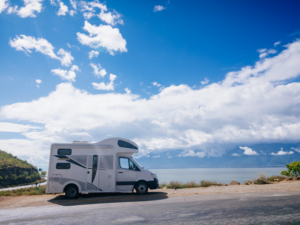
Living
Living in a recreational vehicle is more complicated than short-term camping. Some states, including Alaska, Hawaii, Delaware, Indiana, and Michigan do not allow full-time living in RVs, though there is the possibility of campground hopping. Other states offer more flexibility, but will likely have a variety of both state and local requirements. Many local ordinances require the RV to be parked on personal property or connected to wastewater hookups. Some municipalities require an inspection, a permit, or both. Certain areas may require a permanent foundation or have a size requirement for the lot. Local ordinances may not permit living in a recreation vehicle even if the state does not prohibit doing so. For example, living in an RV on property you own or lease is legal in Missouri for properties within many zones, however Springfield prohibits living in an RV, while Kansas City and Branson do not. In certain areas, temporary RV living is allowed under specific conditions, such as during home construction or extensive repairs, but not as a permanent residence. Restrictions under an HOA may even be more stringent. Most of the properties we sell are not under an HOA.
Whether a lot is conducive to RV living should also be considered. Is it level? Is it covered in trees or brush? In Missouri, an RV parked on personal property must not be visible from the street or road. Are there adequate opportunities for enjoying the outdoors nearby? How simple will securing a septic system be? Needs and must-haves should be weighed in advance.
Camping for the short-term or living in an RV are possible in many areas, but need thoughtful planning in advance. For questions about specific lots, email info@e24land.com. To view land we have available, visit e24land.com.
➡️ Don’t forget to join our VIP Program. This program keeps you informed on coming soon properties, special discounts, and early access to the new properties before we start advertising to the public!!
➡️Check out all our current inventory!